
Nambah Uang Jajan via Internet
3 Desember 2012

Guys, hanya mau sharing aja, beberapa waktu yang lalu (30 October 2012) saya mencoba untuk bergabung di salah satu situs advertisement yang memberikan dollar ketika kita melihat iklan yang di pasang di situs mereka atau yang lebih sering di sebut dengan PTC (Pay To Click).
PTC tersebut adalah Clicksense, awalnya saya ragu untuk bergabung dengan situs ini, tapi setelah saya gabung dan membaca testimonial pengguna yang sudah Cash Out (dapat duit dari situs ini) saya mulai yakin kalau situs ini benar-benar membayar :) dan akhirnya pun saya sekarang sudah mendapatkan 8 Dollar dari beberapa task dan iklan yang telah saya klik di Clicksense.
berikut ini adalah account summary saya di clicksense :)

So, bagi kamu semua yang belum gabung, silahkan aja gabung di situs ini. Itung-itung nabung :) Oh y, untuk pencairannya bisa lewat Paypal, Payza, atau Liberty Reserve. untuk pencairannya nanti akan saya posting lagi belakangan :)
selamat menambah uang jajan ya guys :)
Analysis of “Fire and Ice” Poetry by Robert Frost
18 November 2012
“Analysis of “Fire and Ice” Poetry
by Robert Frost”
(Historical Approach)
IMAGERY
There
is a man talking to himself, he tries to convince his own self about two thing
which clash in his mind. Two different things with different starting point,
different process, but end in a same hole, the end of the world. He seems like
standing in the crossroad and doesn’t know which patch to choose. In a time
when he thinking, He almost believes that a thing, named “fire” is better than
the other, in this case is “ice”. There is a lot of evidence flashing through
in his mind which proves that “fire” is better than “ice”. He ever heard it
from some people who talking about “fire”. A lot of people who already proves
that fire the greatest thing on earth. Those people said that making friend
with fire is good. Making friend with “fire” will make someone’s life “on fire”.
Fire is not only making someone’s life “on fire” but also makes someone’s life
full of desire. In this case, the man, agree with it. Because he ever tastes
what desire is. He ever tastes desire in a form of power. He understands that
having such a big power, especially destructive power like “fire”, is very
great. And from his experience of tasting desire, for a while, he agree that “fire”
is only thing which able to make the world end.
Then
doubtness comes in his mind. He realized that “fire” is not the only one thing
which is destructive. Ice is also destructive thing which exist on earth. He
realized that “Ice” has its own way to destroy the world, calm but deadly. It
makes him think twice. Now he is thinking, again. He tries to find out why the
“Ice” is also destructive. Then he found the way how “ice” destroys a thing. He
realized that “ice” destroys a thing by keeping them inside, “ice” burry a
thing and makes them vanish in a silent way. Just like a people who keep angriness
beneath his heart. He ever heard some people said that angriness which never
been expressed will become “hate”. And if those “hate” become more and more,
and still be saved, it will creates a big power, the power of hate. Then he
realized it, that situation that seems familiar with him. He ever feels it,
keeping his angriness beneath his smile. Then in a moment, that man realized
that “ice” is as destructive as “fire”, and also vice versa. Both have
different way to make the world end. Fire will make the world end on the
unstoppable desire and Ice will make the world end in the deepest most hate.
At
the last gasp, that man just let himself in silent. He stops thinking, start
admiring. He admires the power of the “fire” and the “ice” has. He is between
the devil and the deep blue sea. He can’t choose which one is more destructive,
and he can’t predict how the world will end.
THEORY
A.
New
Historicism
“A simple
definition of the new historicism is that is a method based on the parallel
reading of the literary and non-literary texts, usually of the same historical
period. That is to say, new historicism refuses (at least ostensibly) to
‘previlege’ the literary text: instead of a literary ‘foreground’ and a
historical “background” it envisages and practices a mode of study in which
literary an non-literary texts are given equal weight and constantly inform or
interrogate each other”
(Barry,p.
9)
Based on the definition
above we do historical research by using some data which come from the same
historical period to analyze the literary work. We use that data as the
background of our research and we relate that data with the work itself. In
interpreting the work, we put the literary text within the frame of a non
literary text.
B.
Cold
War
Cold war happened among 1945-1960. Cold
war is competition between the Communist World—primarily
the Soviet Union and allies—and the powers of the Western world, primarily the United States
and its allies. It is fought by all means - propaganda, economic war,
diplomatic haggling and occasional military clashes.
Before we going further, let’s we take
a look at the history of the war (World War I, World War II and Cold War).
World War I is a war between world greatest powers, the central power versus
the allies. The central power including Germany,
Austria-Hungary, Italy and the allies including Britain,
France
and Russia,
United states and others.
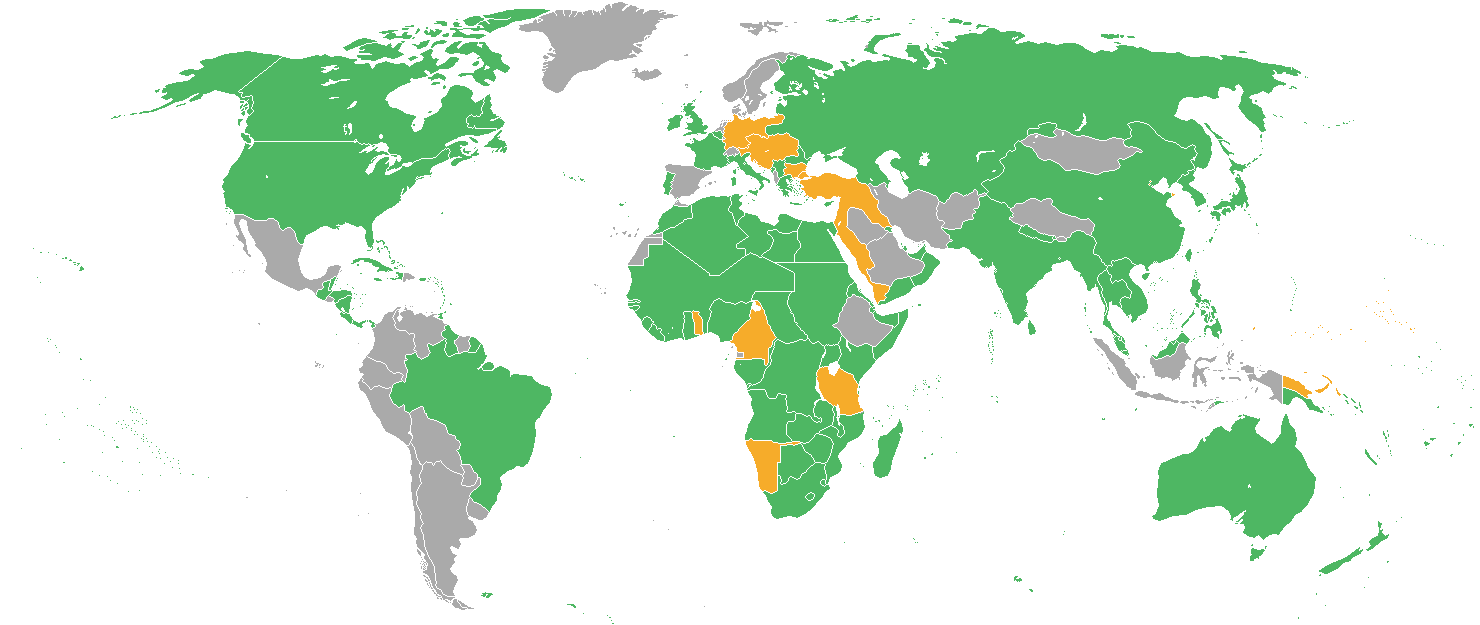
Figure 1
|
Above is the map of the participants in
World War I: Allied Powers in green, Central Powers
in orange and neutral countries in grey. World War I is end with the victory in
the allied side. Allies’ victory creates global change. A lot of changes
aftermath of World War I. One and the worst result of World War I is communism
and socialism become stronger and get new level of popularity. These feelings
were most pronounced in areas directly or harshly affected by the war. Out of
German discontent with the still controversial Treaty of Versailles, Adolf
Hitler was able to gain popularity and power. World War II was in part a
continuation of the power struggle never fully resolved by the First World War;
in fact, it was common for Germans in the 1930s and 1940s to justify acts of
international aggression because of perceived injustices imposed by the victors
of the First World War.
World War II is the war between the
allies ant the axis. The allies including two greatest powers that win the
World War I, United States and Soviet Union, versus the axis (Germany and six
other country). World War II as a part of continuation of the World War I
creates several thing which influence the world. World War II is not only a
physical war but also an Ideology war. Ideology war is started when Germany
brought its Nazi in this war. Nazi which we know as a symbol of communism
changes the world point of view. Even though Germany lost in the World War II
but they still win in spreading the Ideology of communism. Soviet Union, one of
the victors of the World War, use communism for their Ideology. In the other
hand, United States as the other victors of the World War use different
ideology named Liberalism. This different leads a new clash between the victors
of the World War, Soviet Union with its Communism and United States with its
Liberalism. This new war often called as Cold Ward.
The Cold War was the continuing state from roughly 1946 to 1991 of
political conflict, military tension, proxy wars, and economic competition
between the Communist World—primarily the Soviet Union and its satellite states
and allies—and the powers of the Western world, primarily the United States and
its allies. Although the chief military forces never engaged in a major battle
with each other, they expressed the conflict through military coalitions,
strategic conventional force deployments, extensive aid to states deemed
vulnerable, proxy wars, espionage, propaganda, conventional and nuclear arms
races, appeals to neutral nations, rivalry at sports events, and technological
competitions such as the Space Race. The
origins of term “Cold War” is created by an English author and journalist named
George Orwell. At the end of World War II, English author and journalist George
Orwell used the term Cold War in his essay “You and the Atomic Bomb”,
published October 19, 1945, in the British newspaper Tribune.
Contemplating a world living in the shadow of the threat of nuclear warfare, he
warned of a “peace that is no peace”, which he called a permanent “cold war”,
Orwell directly referred to that war as the ideological confrontation between
the Soviet Union and the Western powers. Cold war is more dangerous than World War
I and World War II. “…the Cold War is marked by both the ideological dimension
and by the crudest definition of power, the military one. Thus what made the
Soviet Union look as a formidable threat to the other Western countries in 1945
was not just its subversive ideology or its military power, but the combination
of both plus the contemporary vacuum which opened up in central Europe
at the end of World War II – a vacuum which made Soviet power appear as even
more impressive that it may have actually been.” (Reinterpreting the End of the
Cold War, p.46). This
ideology war is spreading around the world. Both of them try to doctrine
another country to use their ideology. One of the results, Korea divided into
two parts, North Korea and South Korea. This thing happened because north and
south Korea has different ideology.
ANALYSIS
Fire
and Ice
Robert
Frost
Some
say the world will end in fire,
Some
say in ice.
From
what I’ve tasted of desire
I
hold with those who favor fire.
But
if it had to perish twice,
I
think I know enough of hate
To
know that for destruction ice
Is
also great
And
would suffice.
Fire
and ice is one of Robert Frost's most popular poems, published in December 1920
in Harper's Magazine and in 1923 in his Pulitzer-prize winning book New
Hampshire. The years when the poetry made is the same years when a big
event in this world happened, World War. We’ll try to put the “fire and ice”
within the frame of a non literary text, in here is data about World war I,
world war II and Cold War. We’ll try to correlate what the thing inside this
poetry with the thing outside this poetry when its made.
First,
we’ll find out what “thing” that represented by the word “some” then we go to
interpret the words “fire” and “ice” which can leads to the “end of the world”.
Some
say
|
|
Fire
|
Ice
|
End
of the world
|
End
of the world
|
By
using the theory and data about Cold War, I interpret the word “Fire” as the
“Liberalism” and the word “Ice” as the “Communism”. The reason is, “Fire”
represent something related with desire. In here, by viewing the result of the
Cold War, America (with their Liberalism ideology) has a big desire, desire to
create world with liberalism. As we know, aftermath of the World War II there
are two greatest powers who leads the allies, America and Soviet Union. In the
vacuum time after World War II, Soviet power appear as even more impressive
that it may have actually been. This thing leads America to do something. They
try to tackle-down the Soviet power. Their effort is not by performing an open
war like World War I and World War II. They prefer to do “peacefully war”. The
thing that America wants to tackle-down is the Soviet ideology which seem will
spread all around the world. If this thing is not stopped, the communism will
be the world ideology. That is why America feels being threatened by Soviet.
“Peace
that is no peace” that what Orwell, an English author and journalist, said. It
means there is no “peace” in peace. Both, America and Soviet, are fighting each
other ideology. They are not performing war but they do propaganda, economic
war, diplomatic haggling and occasional military clashes. And in here, America
“seems” win the game. Liberalism is accepted in many countries around the
world. Many countries around the world support the idea of the importance of
liberty and equal right. Some country uses the principle of Liberalism to build
their own Ideology and some country use the Liberalism as their ideology. Liberalism
is not only bringing “the world ideology” but also destructing the previous
ideology that every country in this world has. Some of these country never realized
that the Liberalism, slow but sure, become their ideology. In the other hand,
communism seems “lose the game”. But actually, they not “fully lose the game”
because the communism is still exist in this world. Communism just loses in
amount, but they never lose the power. Communism is not only bringing an
ideology but also bring a destructive power within. The existence of North and
South Korea is one of the result clashes of ideology. A part of Korea use
communism and the other is not. That is why Korea separated into North and
South Korea. Both of them are separated by clash of ideology.
Now
it is clear that the word “some” in this poetry is referring country (with its
people) who support one of two ideology above (liberalism and communism). “Some say the world will end in
fire” the word “some” refer countries in this world which use Liberalism as
their Ideology. “Some say in
ice.” The word “some” refers the country in this world which use communism as
their ideology. Communism and Liberalism are two different things. Communism
which is loses in amount seems hate the existence of liberalism. Liberalism is
viewed as a thread for the existence of Communism, vice versa. That is why “some” people agree that Liberalism is
“better” than Communism, vice versa.
“End
of the world” in this poetry doesn’t mean like Armageddon. “End of the world”
here refer the existence of two ideology above (liberalism and communism). “Some
say the world will end in fire”
means that all the country (and its people) in this world use liberalism as
their ideology. In the other hand “Some say (the world will end) in ice.” means that all the country
(and its people) in this world use communism as their ideology. Which one will
be the end of the world? We’ll never know. It is just the matter of time. The
way people thought is one of big factor in this process.
Bibliography
Barry, Peter (2002) An Introduction to literary and cultural
theory, Manchester University Press
Pons,
Silvio and Romero, Federico (2005) Reinterpreting the End of the Cold War; Issues, interpretations, periodizations, Frank Cass
Robert
Frost, "Fire and Ice", in the selection "A Group of Poems"
by Robert Frost, Harper's Magazine , December 1920, p. 67.
Analysis of “Fire and Ice” Poetry by Robert Frost
“Analysis of “Fire and Ice” Poetry
by Robert Frost”
(Historical Approach)
IMAGERY
There
is a man talking to himself, he tries to convince his own self about two thing
which clash in his mind. Two different things with different starting point,
different process, but end in a same hole, the end of the world. He seems like
standing in the crossroad and doesn’t know which patch to choose. In a time
when he thinking, He almost believes that a thing, named “fire” is better than
the other, in this case is “ice”. There is a lot of evidence flashing through
in his mind which proves that “fire” is better than “ice”. He ever heard it
from some people who talking about “fire”. A lot of people who already proves
that fire the greatest thing on earth. Those people said that making friend
with fire is good. Making friend with “fire” will make someone’s life “on fire”.
Fire is not only making someone’s life “on fire” but also makes someone’s life
full of desire. In this case, the man, agree with it. Because he ever tastes
what desire is. He ever tastes desire in a form of power. He understands that
having such a big power, especially destructive power like “fire”, is very
great. And from his experience of tasting desire, for a while, he agree that “fire”
is only thing which able to make the world end.
Then
doubtness comes in his mind. He realized that “fire” is not the only one thing
which is destructive. Ice is also destructive thing which exist on earth. He
realized that “Ice” has its own way to destroy the world, calm but deadly. It
makes him think twice. Now he is thinking, again. He tries to find out why the
“Ice” is also destructive. Then he found the way how “ice” destroys a thing. He
realized that “ice” destroys a thing by keeping them inside, “ice” burry a
thing and makes them vanish in a silent way. Just like a people who keep angriness
beneath his heart. He ever heard some people said that angriness which never
been expressed will become “hate”. And if those “hate” become more and more,
and still be saved, it will creates a big power, the power of hate. Then he
realized it, that situation that seems familiar with him. He ever feels it,
keeping his angriness beneath his smile. Then in a moment, that man realized
that “ice” is as destructive as “fire”, and also vice versa. Both have
different way to make the world end. Fire will make the world end on the
unstoppable desire and Ice will make the world end in the deepest most hate.
At
the last gasp, that man just let himself in silent. He stops thinking, start
admiring. He admires the power of the “fire” and the “ice” has. He is between
the devil and the deep blue sea. He can’t choose which one is more destructive,
and he can’t predict how the world will end.
THEORY
A.
New
Historicism
“A simple
definition of the new historicism is that is a method based on the parallel
reading of the literary and non-literary texts, usually of the same historical
period. That is to say, new historicism refuses (at least ostensibly) to
‘previlege’ the literary text: instead of a literary ‘foreground’ and a
historical “background” it envisages and practices a mode of study in which
literary an non-literary texts are given equal weight and constantly inform or
interrogate each other”
(Barry,p.
9)
Based on the definition
above we do historical research by using some data which come from the same
historical period to analyze the literary work. We use that data as the
background of our research and we relate that data with the work itself. In
interpreting the work, we put the literary text within the frame of a non
literary text.
B.
Cold
War
Cold war happened among 1945-1960. Cold
war is competition between the Communist World—primarily
the Soviet Union and allies—and the powers of the Western world, primarily the United States
and its allies. It is fought by all means - propaganda, economic war,
diplomatic haggling and occasional military clashes.
Before we going further, let’s we take
a look at the history of the war (World War I, World War II and Cold War).
World War I is a war between world greatest powers, the central power versus
the allies. The central power including Germany,
Austria-Hungary, Italy and the allies including Britain,
France
and Russia,
United states and others.
|
Figure 1
|
Above is the map of the participants in
World War I: Allied Powers in green, Central Powers
in orange and neutral countries in grey. World War I is end with the victory in
the allied side. Allies’ victory creates global change. A lot of changes
aftermath of World War I. One and the worst result of World War I is communism
and socialism become stronger and get new level of popularity. These feelings
were most pronounced in areas directly or harshly affected by the war. Out of
German discontent with the still controversial Treaty of Versailles, Adolf
Hitler was able to gain popularity and power. World War II was in part a
continuation of the power struggle never fully resolved by the First World War;
in fact, it was common for Germans in the 1930s and 1940s to justify acts of
international aggression because of perceived injustices imposed by the victors
of the First World War.
World War II is the war between the
allies ant the axis. The allies including two greatest powers that win the
World War I, United States and Soviet Union, versus the axis (Germany and six
other country). World War II as a part of continuation of the World War I
creates several thing which influence the world. World War II is not only a
physical war but also an Ideology war. Ideology war is started when Germany
brought its Nazi in this war. Nazi which we know as a symbol of communism
changes the world point of view. Even though Germany lost in the World War II
but they still win in spreading the Ideology of communism. Soviet Union, one of
the victors of the World War, use communism for their Ideology. In the other
hand, United States as the other victors of the World War use different
ideology named Liberalism. This different leads a new clash between the victors
of the World War, Soviet Union with its Communism and United States with its
Liberalism. This new war often called as Cold Ward.
The Cold War was the continuing state from roughly 1946 to 1991 of
political conflict, military tension, proxy wars, and economic competition
between the Communist World—primarily the Soviet Union and its satellite states
and allies—and the powers of the Western world, primarily the United States and
its allies. Although the chief military forces never engaged in a major battle
with each other, they expressed the conflict through military coalitions,
strategic conventional force deployments, extensive aid to states deemed
vulnerable, proxy wars, espionage, propaganda, conventional and nuclear arms
races, appeals to neutral nations, rivalry at sports events, and technological
competitions such as the Space Race. The
origins of term “Cold War” is created by an English author and journalist named
George Orwell. At the end of World War II, English author and journalist George
Orwell used the term Cold War in his essay “You and the Atomic Bomb”,
published October 19, 1945, in the British newspaper Tribune.
Contemplating a world living in the shadow of the threat of nuclear warfare, he
warned of a “peace that is no peace”, which he called a permanent “cold war”,
Orwell directly referred to that war as the ideological confrontation between
the Soviet Union and the Western powers. Cold war is more dangerous than World War
I and World War II. “…the Cold War is marked by both the ideological dimension
and by the crudest definition of power, the military one. Thus what made the
Soviet Union look as a formidable threat to the other Western countries in 1945
was not just its subversive ideology or its military power, but the combination
of both plus the contemporary vacuum which opened up in central Europe
at the end of World War II – a vacuum which made Soviet power appear as even
more impressive that it may have actually been.” (Reinterpreting the End of the
Cold War, p.46). This
ideology war is spreading around the world. Both of them try to doctrine
another country to use their ideology. One of the results, Korea divided into
two parts, North Korea and South Korea. This thing happened because north and
south Korea has different ideology.
ANALYSIS
Fire
and Ice
Robert
Frost
Some
say the world will end in fire,
Some
say in ice.
From
what I’ve tasted of desire
I
hold with those who favor fire.
But
if it had to perish twice,
I
think I know enough of hate
To
know that for destruction ice
Is
also great
And
would suffice.
Fire
and ice is one of Robert Frost's most popular poems, published in December 1920
in Harper's Magazine and in 1923 in his Pulitzer-prize winning book New
Hampshire. The years when the poetry made is the same years when a big
event in this world happened, World War. We’ll try to put the “fire and ice”
within the frame of a non literary text, in here is data about World war I,
world war II and Cold War. We’ll try to correlate what the thing inside this
poetry with the thing outside this poetry when its made.
First,
we’ll find out what “thing” that represented by the word “some” then we go to
interpret the words “fire” and “ice” which can leads to the “end of the world”.
|
Some
say
|
|
|
Fire
|
Ice
|
End
of the world
|
End
of the world
|
By
using the theory and data about Cold War, I interpret the word “Fire” as the
“Liberalism” and the word “Ice” as the “Communism”. The reason is, “Fire”
represent something related with desire. In here, by viewing the result of the
Cold War, America (with their Liberalism ideology) has a big desire, desire to
create world with liberalism. As we know, aftermath of the World War II there
are two greatest powers who leads the allies, America and Soviet Union. In the
vacuum time after World War II, Soviet power appear as even more impressive
that it may have actually been. This thing leads America to do something. They
try to tackle-down the Soviet power. Their effort is not by performing an open
war like World War I and World War II. They prefer to do “peacefully war”. The
thing that America wants to tackle-down is the Soviet ideology which seem will
spread all around the world. If this thing is not stopped, the communism will
be the world ideology. That is why America feels being threatened by Soviet.
“Peace
that is no peace” that what Orwell, an English author and journalist, said. It
means there is no “peace” in peace. Both, America and Soviet, are fighting each
other ideology. They are not performing war but they do propaganda, economic
war, diplomatic haggling and occasional military clashes. And in here, America
“seems” win the game. Liberalism is accepted in many countries around the
world. Many countries around the world support the idea of the importance of
liberty and equal right. Some country uses the principle of Liberalism to build
their own Ideology and some country use the Liberalism as their ideology. Liberalism
is not only bringing “the world ideology” but also destructing the previous
ideology that every country in this world has. Some of these country never realized
that the Liberalism, slow but sure, become their ideology. In the other hand,
communism seems “lose the game”. But actually, they not “fully lose the game”
because the communism is still exist in this world. Communism just loses in
amount, but they never lose the power. Communism is not only bringing an
ideology but also bring a destructive power within. The existence of North and
South Korea is one of the result clashes of ideology. A part of Korea use
communism and the other is not. That is why Korea separated into North and
South Korea. Both of them are separated by clash of ideology.
Now
it is clear that the word “some” in this poetry is referring country (with its
people) who support one of two ideology above (liberalism and communism). “Some say the world will end in
fire” the word “some” refer countries in this world which use Liberalism as
their Ideology. “Some say in
ice.” The word “some” refers the country in this world which use communism as
their ideology. Communism and Liberalism are two different things. Communism
which is loses in amount seems hate the existence of liberalism. Liberalism is
viewed as a thread for the existence of Communism, vice versa. That is why “some” people agree that Liberalism is
“better” than Communism, vice versa.
“End
of the world” in this poetry doesn’t mean like Armageddon. “End of the world”
here refer the existence of two ideology above (liberalism and communism). “Some
say the world will end in fire”
means that all the country (and its people) in this world use liberalism as
their ideology. In the other hand “Some say (the world will end) in ice.” means that all the country
(and its people) in this world use communism as their ideology. Which one will
be the end of the world? We’ll never know. It is just the matter of time. The
way people thought is one of big factor in this process.
Bibliography
Barry, Peter (2002) An Introduction to literary and cultural
theory, Manchester University Press
Pons,
Silvio and Romero, Federico (2005) Reinterpreting the End of the Cold War; Issues, interpretations, periodizations, Frank Cass
Robert
Frost, "Fire and Ice", in the selection "A Group of Poems"
by Robert Frost, Harper's Magazine , December 1920, p. 67.
Regional Dialect and Social Dialect
16 November 2012
SOCIOLINGUISTICS
Regional Dialect and Social Dialect
of Gambler Community in Freedom Studio Music Caruban
CHAPTER
I
INTRODUCTION
A.
Background
Caruban
is a developing town. A lot of people from around East Java come to this town.
They come to the Caruban for reasons, to find a job, settle a house, and more. Those
people who come to Caruban also bring their previous culture in form of
language. We can found that Caruban is not only inhabited by “the original
caruban people” (who born and live in Caruban) but also inhabited by another
people who come from another place around East Java and maybe around Indonesia.
Language is one indicator that can be used to indicate where people come from.
We know that most of Caruban people are speak Javanese. Then, how we can
determine which one is a “pure-caruban-people” and which one is “half-blood-caruban-people”?
The answer is simple (without being simplistic); we can use dialect to support
our analysis.
As we know, there are
two kind of dialect; regional dialect and social dialect. Regional dialects
involve features of pronunciation, vocabulary, and grammar which differ
according to the geographical area the speakers come from. The dialect of
Surabaya people with Jember people or Caruban people is different though they
use the same language, Javanese. Prototype of Caruban people is almost same
with the Madiun’s people. That is the reason why we can use regional dialect to
find out where someone is come from. Social dialect is distinguished by feature
of pronunciation, vocabulary and grammar according to the social group of the
speaker. Meanwhile, social group is usually determined by range of features,
such as education, occupation, resident area and income level. So, people who
come from different social groups speak different social dialects if the use
different words, pronunciation, and grammatical features. This thing is also
happen in Caruban. There are various kinds of social groups in this town. One
of a kind is Gambler group which exists in Freedom Studio Music Caruban. This
gambler group is consisting of people who come from around East Java. With this
reason, researcher wants to conduct a research on “Regional Dialect and Social Dialect of Gambler in Freedom Studio Music
Caruban”
B.
Research Question
Based on above explanation, researcher has two
research questions in this study that will give guidance in conducting this
research as follows;
1.
Is there any feature of
regional dialect which is used by the gambler in Freedom studio music Caruban?
2.
Is there any feature of
social dialect which is used by the gambler in Freedom studio music Caruban?
C.
Goals and Objectives
Researcher has goals to answer all the question
of this research as follows;
1.
to prove that there are
features of regional dialect used by the gambler in Freedom studio music
Caruban
2.
to prove that there are
features of social dialect which is used by the gambler in Freedom studio music
Caruban.
D.
Limitation of the Study
The
researcher limits this study on the pronunciation, vocabulary and grammar of
Regional Dialect and Social Dialect
CHAPTER II
THEORITICAL FRAMEWORK
A.
Language Varieties
It is very natural that
two persons from the same speech community, for example the East Java, seem to
use a little bit different pronunciation and even grammar in their
communication. They actually use the Javanese language as they are still able
to understand each other. The differences in pronunciation and grammar of a
language do not lead to the existence of two distinct languages, but they are
only varieties of a language. Variety can be defined as a set of linguistic
items including pronunciation, words, and grammar with similar distribution
associated with geographical or social factors. According to Wardhaugh, variety
is defined in terms of a specific set of linguistic items or human speech
patterns presumably, sound, words, and grammatical features which can uniquely
associate with some external factors presumably a geographical area or a social
group (Wardhaugh, 2006: 22).
The Javanese language
that is geographically used by the people from East Java and Central Java varies
according to the users’ regions and social classes. Seen from the region where
the people stay, Javanese language has several varieties. For most people from
East Java, the language they use is partially characterized by the sound /ó/ dominance
(different pronunciation), low style, vocabulary, grammar, and no honorifics.
This variety is named as ngoko biasa as in kowé mangan opo? (What are you eating?); In the
other hand, the people who live in the central Java, their language is
partially characterized by the sound /a/ dominance (different pronunciation),
low and high style, vocabulary, grammar, and low and high honorifics. This
variety is called as ngoko sae/madya and kromo as in sampéjan
maem nopo? (What are you eating). For the people who have a higher
social class, the language is partially characterized by the high style and
honorifics as in panjenengan dahar menópó (What are you eating).This
variety is called krama inggil. Javanese
social status is reflected not just in choice of linguistic forms but also in
the particular combination of forms which each social group customarily uses,
i.e. the varieties or stylistic levels that together make up the group’s
distinctive dialect. as the word “you” can be said in three different way (kowé,
sampéjan, pandjenengan), the word “eat” can be said in three different
words (mangan, maem, dahar), another example which taken from Geertz in
Holmes, is the word “now” which said in three different Javanese word (Saiki,
Saniki, Samenika)
The varieties of a
language that differ in some of pronunciation, words, and grammars from the
others are known as dialect. Hudson in Wardhaugh defines a variety of
language as ‘a set of linguistic items with similar distribution,’ A
variety can therefore be something greater than a single language as well as
something less, less even than something traditionally referred to as a
dialect. The dialect which is associated with regional factors is called regional
dialect. Regional dialects involve features of pronunciation, vocabulary,
and grammar which differ according to the geographical area the speakers come
from. The other one which is associated with social class status is known as social
dialect. Social dialect is distinguished by feature of pronunciation,
vocabulary and grammar according to the social group of the speaker. Those two
things above highly affected by social class and social status. Teacher does
not talk like office cleaners, lawyers do not speak in the same way as the
gambler did. People from different social class and social status speak
differently.
CHAPTER
III
ANALYSIS
Pronunciation as part
of Regional Dialect used by the Gambler
(03:00-03:02)
“Edy ketok é ra tau main yo uaaaangél
lo, tenan!…”
Madiun
people often use longer vowel in a word to create comparative and sometime
hyperbole meaning toward the word pronounced. For example, the word “angél” (Difficult) which pronounced “uangéééél” has a same meaning with “more
difficult” or “uaaaaanguuuuél” has a
same meaning with “most difficult”. Degrees of comparison in Madiun people are
indicated with the stretch of the vowel inside a word.
Positive
|
Angél
|
Difficult
|
Comparative
|
Uangél
|
More
difficult
|
Superlative
|
Uuaaaanguuuuuél
|
Most difficult
|
Table 1
As
the feature of regional dialect, pronunciation also bring grammatical rule.
This is happen on the Madiun people speech. From the table one, we could see
that the word “angél” which is
pronounced in different way will creates another meaning, in this case will
showing the degrees of comparison. This thing is only happen in Madiun people
and in several places near Madiun. Caruban which is very close with Madiun is
highly affected with this pronunciation. Some people in Caruban often use this
pronunciation in their speech. Regional
variation in the way a language is spoken is likely to provide one of the
easiest ways of observing variety in language.
Accent as part of Regional
Dialect used by the Gambler
(04:47-04:50)
“Biasane wes tau menang tapi gak tau nóthók yo gak skill aku…”
The
bold-italicized word commonly pronounced “nuthók” by some people in Caruban and
Madiun region. But here, the researcher found that the word “nuthók” is
pronounced “Nóthók”. This word is pronounced by a man named Gunawan. The
researcher tries to find out who Gunawan is. Then the researcher found several
facts about Gunawan. Gunawan comes from outside of Caruban and Madiun region.
He comes from Jombang. That is the reason why the word “nuthók” is pronounced
“Nóthók”. People in the Eastern part of East java sometimes replace the vowel
“u” with “ó” (see table 2). This is proving that regional dialect is a massive
thing that cannot be replaced easily by exposing a new dialect in new place.
Researcher gets a fact that Gunawan had live in Caruban for 2 years but his
accent never change. His “Eastern East Java accent” still exists in every
speech he made.
Word
|
Western
part of East Java
|
Eastern
part of East Java
|
Nuthók
|
Nuthók
|
Nóthók
|
Njupók
|
Njupók
|
Njópók
|
Nguyóh
|
Nguyóh
|
Ngóyóh
|
Table 2
Word or vocabulary as
part of Social Dialect used by the Gambler
(09:40-09:43)
…Lha ngitét yo..
ngitét
is another word which has same meaning with “Njupuk” “Njikuk” (take). But the
word “ngitét” is only used in gambling. The word “ngitét” can be said as the
register in this social group (community of gambler). That word is rarely used
in a daily life. That word is not interchangeable like the word “Njupuk” which
can replace the word “Njikuk”. Here is the example;
1. Aku
wes njupuk kartu
2. Aku
wes njikuk kartu
3. Aku
wes ngitét kartu
|
I
have already take the card
|
1. Aku
wes njupuk mobil
2. Aku
wes njikuk mobil
3. Aku
wes ngitét mobil*
|
I
have already take the car
|
Table 3
*3rd
sentence is not acceptable because of selectional restriction.
The word “ngitét” is
neither a register nor slang. That word is a variety of the word “njupuk”. The
existence of this word is due to the social dialect. This social group (gambler
community) uses this word in a card game. In a different social group, the word
“ngitét” sometimes never be used.
CHAPTER
IV
CONCLUSION
As we have seen,
many varieties of language exist and each language exists in a number of
guises. However, languages do not vary in every possible way. It is still quite
possible to listen to an individual speaker and infer very specific things
about that speaker after hearing relatively little of his or her speech. The
interesting problem is accounting for our ability to do that.
The existence of
different varieties is interesting in still another respect. While each of us
may have productive control over only a very few varieties of a language, we
can usually comprehend many more varieties and relate all of these to the
concept of a ‘single language.’ That is, our receptive linguistic
ability is much greater than our productive linguistic ability. An
interesting problem for linguists is knowing how best to characterize this
‘knowledge’ that we have which enables us to recognize something as being in
the language but yet marked as ‘different’ in some way.
BIBLIOGRAPHY
Wardhaugh,
Ronald (2006) An Introduction to
Sociolinguistic (Fifth Edition); Blackwell Publishing
Holmes,
Janet; An Introduction to Sociolinguistic
(Second Edition); Longman
Data
is taken on Wednesday, 4th January 2012 between 22:13 pm until 22.27
pm. Original data is in video mp4 format file which is taken by using Samsung
GT B3210. Video’s duration is 14 minutes and 29 seconds.
Note:
-Ini saya posting hanya untuk tujuan pendidikan saja :) supaya teman-teman jadi tambah referensinya :) bukan untuk di jiplak :)
Note:
-Ini saya posting hanya untuk tujuan pendidikan saja :) supaya teman-teman jadi tambah referensinya :) bukan untuk di jiplak :)
Langganan:
Postingan (Atom)
ClickSense

NEOBUX

My Twitter

My Facebook
